
Raptor X5 and Raptor X7:Inside Tekdense's ANSI/VITA 90.0 VNX+ Mission Computer Lineup
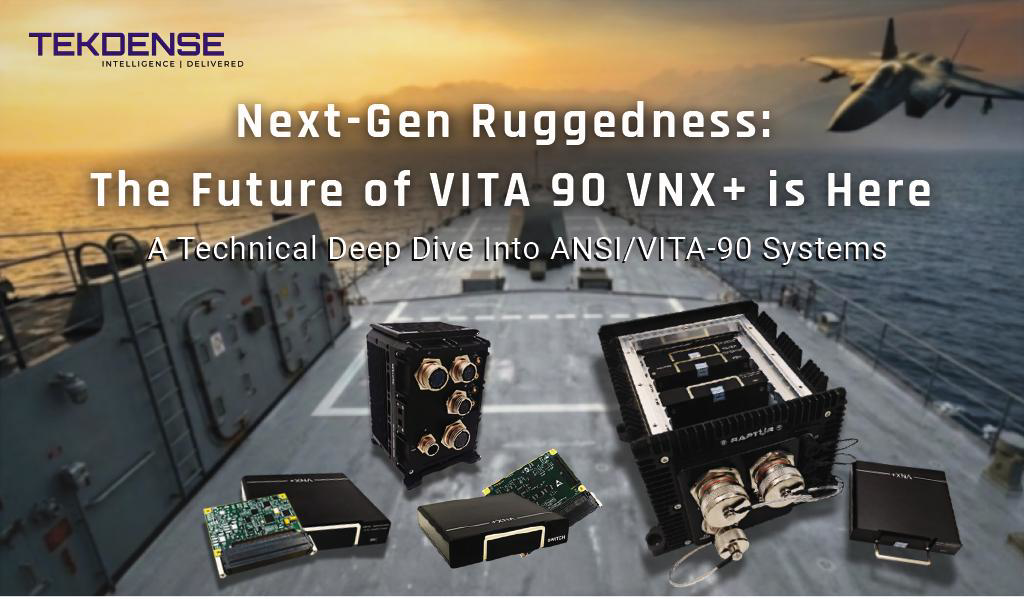
The push toward open-standard embedded computing in defense and aerospace has never been stronger than with the emergence of VNX+ (VITA 90) compliant platforms. Tekdense's rugged mission computers — specifically the Raptor X5 and Raptor X7—represents the pinnacle of this standard in two distinct form factors, both engineered for mission-critical environments.
This blog explores the VNX+ (ANSI/VITA 90) embedded systems architecture, module configurations, I/O capabilities, and key differences to help system integrators and program engineers select the right platform.
Raptor X5: The 5-Slot VNX+ Small Form Factor Integrated System
The Raptor X5 is a 5-slot VNX+ embedded system optimized for applications where platform footprint is the primary constraint. These high-performance embedded defense computers deliver a complete embedded computing stack—processing, AI acceleration, power management, and I/O—in a compact conduction-cooled chassis.
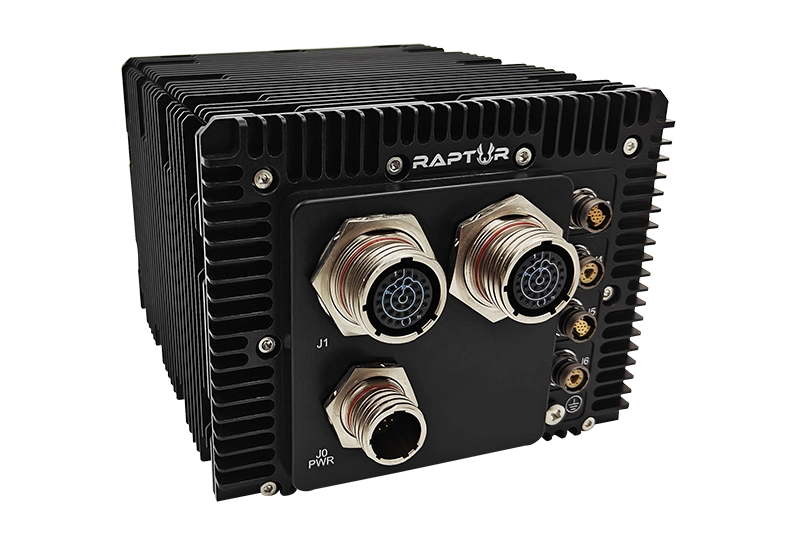
5-Slot VNX+ System Technical Specifications
- Dimensions: 178 x 122 x 174 mm (7.00 x 4.80 x 6.85 inches)
- Weight: ~3.7 kg (~8.1 lbs)
- Cooling: Conduction cooled, fanless
- Input Power: 12–32VDC, 28VDC nominal
- Operating Temperature: -20°C up to +71°C (with integrated VNX+ GPGPU / with assisted airflow)
- Storage Temperature: -40°C to +85°C
- Compliance: MIL-STD-461G, MIL-STD-704F/1275F, MIL-STD-810H
Raptor X5 Slot Configuration - VNX+ Modular Architecture
The Raptor X5 backplane is configured as follows across its 5 slots:
- Slot 1 — EMI Filter Module
- Slot 2 — PSU Module
- Slot 3 — Holdup Module
- Slot 4 — GPU Module (NVIDIA Jetson Orin NX)
- Slot 5 — SBC Module (Intel® Core™ i7-1185GRE)
Raptor X7: The 7-Slot Rugged VNX+ Small Form Factor Integrated System
The Raptor X7 extends the Raptor platform to a 7-slot configuration, adding dedicated Ethernet switching and an I/O carrier module to address more I/O-intensive and networked mission profiles. It is described as the first-of-its-kind in the market for a full VNX+ 7-slot modular rugged computing platform.
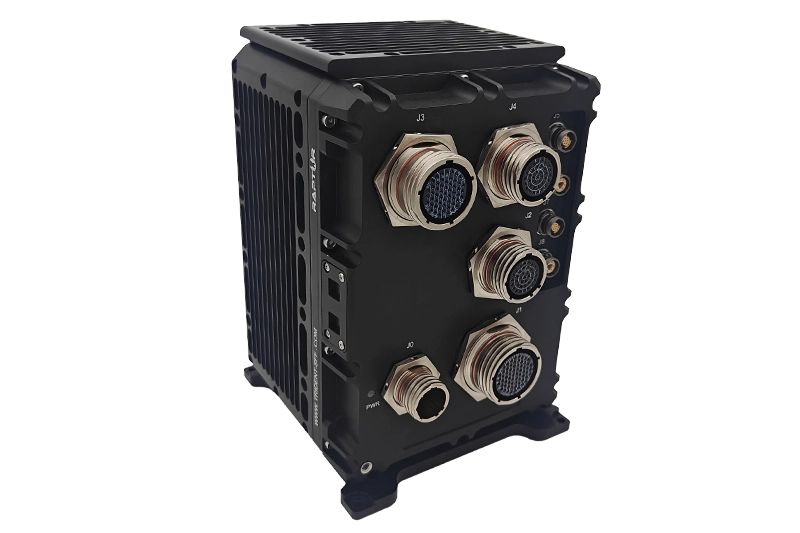
7-Slot VNX+ System Technical Specifications
- Dimensions: 130 x 193.5 x 133 mm (5.10 x 7.60 x 5.25 inches)
- Weight: ~4.2 kg (~9.25 lbs)
- Cooling: Conduction cooled, fanless
- Input Power: 12–32VDC, 28VDC nominal
- Operating Temperature: -20°C up to +71°C (with integrated VNX+ GPGPU / with assisted airflow)
- Storage Temperature: -40°C to +85°C
- Compliance: MIL-STD-461G, MIL-STD-704F/1275F, MIL-STD-810H
Raptor X7 Slot Configuration - VNX+ Modular Architecture
The X7's 7-slot backplane is configured as follows:
- Slot 1 — PSU Module
- Slot 2 — EMI Filter Module
- Slot 3 — GPGPU Module
- Slot 4 — Holdup Module
- Slot 5 — Ethernet Switch Module
- Slot 6 — IO Carrier Module
- Slot 7 — SBC Module
Compliance and Standards
Both platforms carry the same compliance stack: MIL-STD-810H, MIL-STD-461G, MIL-STD-704F/1275F. This alignment with key defense standards significantly reduces the certification burden for program integrators.
Application Fit
The Raptor X5 and X7 are purpose-built VNX+ rugged embedded mission computers for applications including secure communications, advanced surveillance, real-time data and image processing, command and control, target tracking, navigation, and process monitoring.
The GPU module's NVIDIA Jetson Orin NX accelerates AI inference workloads across these domains. The Intel® Core™ i7 SBC handles general-purpose compute, OS operations, and application software. Third-party VNX+ module integration means both platforms can be extended over time as mission requirements evolve — a critical lifecycle consideration for long-duration defense programs.
Raptor X5 vs Raptor X7: Choosing the Right VNX+ Mission Computer
The choice between the ANSI/VITA 90 standards-compliant Raptor X5 and Raptor X7 comes down to mission I/O requirements and network complexity:
- Raptor X5 is the right choice when platform footprint is the overriding constraint and I/O requirements are satisfied by 2 x DP, 2 x USB 3.0, 2 x USB 2.0, 2 x 1GbE, 4 x GPIO, and 4 x RS-232.
- Raptor X7 is appropriate where networked operation is required (8-port Ethernet switch), where CAN bus and RS-422 are necessary, or where expansion via miniPCIe/AcroPack modules is needed
- Both platforms share processor and GPU specifications, MIL-STD compliance, and conduction-cooled fanless thermal design
Conclusion
The Raptor X5 and Raptor X7 represent two distinct but complementary systems of the ANSI/VITA 90 VNX+ open standard. The X5 delivers a complete embedded computing stack in a highly compact 5-slot configuration. The X7 extends that foundation with dedicated Ethernet switching, expanded serial and bus I/O, and PCIe expansion capability in a 7-slot chassis. Both are VNX+ (VITA 90) compliant, MIL-STD qualified, and built for the realities of deployed field operation.
Explore the Raptor X5 or Raptor X7 for your program — contact Tekdense for detailed module specifications, configuration options, and integration support.
Reach us at sales@tekdense.com | +1 305-317-3646 (US)